
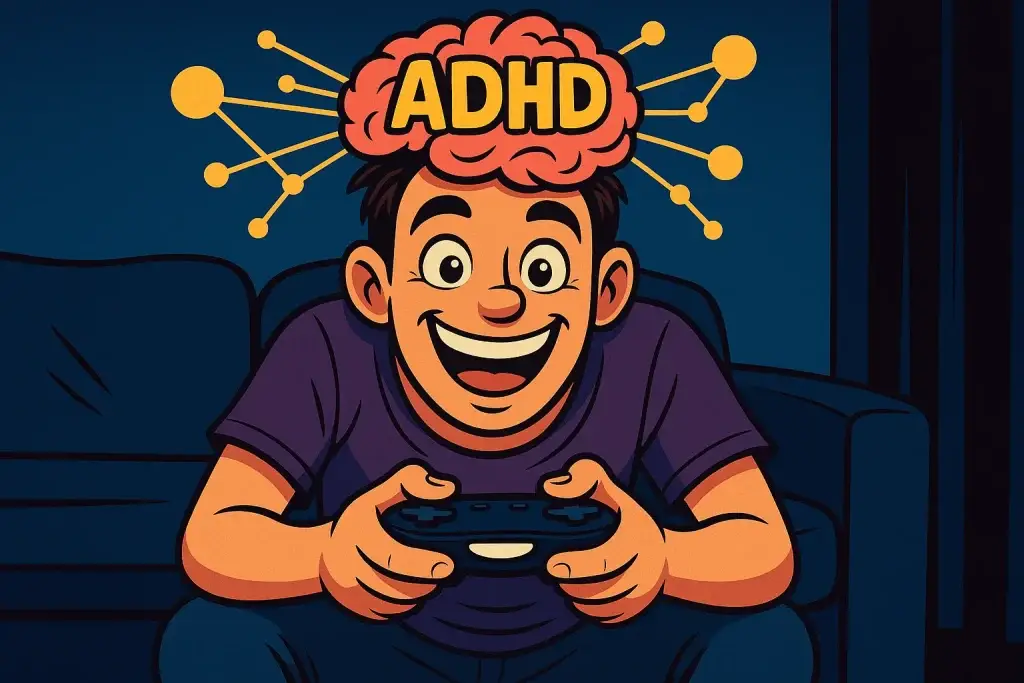
Why Gaming Feels So Right for ADHD
I’ve been gaming since I was a kid. I mean, some of my earliest memories are button-mashing on a controller that was way too big for my hands. Fast-forward to today, and here I am—grown, mostly responsible, and still lowkey obsessing over loadouts, strategies, and whether I should’ve queued up one more match before bed. (Spoiler: I shouldn’t have.)
But here’s the thing—gaming and ADHD have a real connection. Like, for better or worse, games know exactly how to keep our brains hooked. The instant feedback, the constant novelty, the feeling of accomplishment? *Chef’s kiss* for a dopamine-hungry brain.
How Games Help the ADHD Brain
There’s something kind of beautiful about how games meet our brains where they’re at. No need to decode body language, no real-life deadlines (well, except bedtime, but let’s not talk about that), and everything is clear, structured, and rewarding.
- Instant gratification: You do a thing, you get a reward. Simple. Effective. Kinda addictive.
- Hyperfocus zone: Ever lost 3 hours without realizing it? Yeah, that’s called “flow,” and it’s actually a superpower when channeled right.
- Clear goals and feedback: Unlike school or jobs where the rules are vague or change every week, games lay it out clearly. Win = reward. Lose = try again. Very ADHD-friendly.
Even this article on “Do Games Help ADHD or Hinder?” dives deeper into the potential pros and cons, especially for younger players. But honestly? A lot of it applies to us grown-up gamers too.
When Gaming Goes Off the Rails
Alright, let’s be real—sometimes it’s not just “one more game.” It’s 3 AM, and you’re still in queue, ignoring your blinking to-do list and wondering how it got so late. Again.
This is where things get tricky. Because for all the good, games can absolutely hijack your brain if you're not careful. And if you’re anything like me, there's a fine line between “I needed this break” and “welp, I’ve escaped reality for 6 hours again.”
It’s especially hard when you’re already struggling to stay motivated, or worse, feeling like you’re just lazy (which you’re not, by the way—this piece on ADHD or Laziness hits that whole conversation on the head).
Some Strategies That Actually Help
So what do we do? Quit games forever and take up knitting? Nah. But here’s what’s been working for me, more or less:
- Play with intention. Not every session needs a mission, but knowing *why* you’re playing helps. Is it to relax? Socialize? Escape? (All valid—just good to know.)
- Set a “last game” timer. I’ll legit ask Siri to remind me in 45 minutes. When it goes off, that’s my wrap-up cue. Is it always successful? Not at all. But it helps.
- Notice the vibes. After gaming, check in with yourself. Are you feeling energized or kinda zonked? That tells you whether that session was helpful or too much.
And look, no shame if you do overdo it sometimes. ADHD isn’t about perfect discipline—it’s about understanding your patterns and finding ways to work with them.
Let Games Be Part of the Solution, Not the Problem
I don’t want to live in a world where I can’t queue up for a quick round of Rocket League or roam around in Elden Ring. Games are part of who I am. They help me feel capable, focused, and even social when I’m in the right headspace. They’re not the enemy.
The trick is just remembering that you’re the one holding the controller. Not the other way around.