
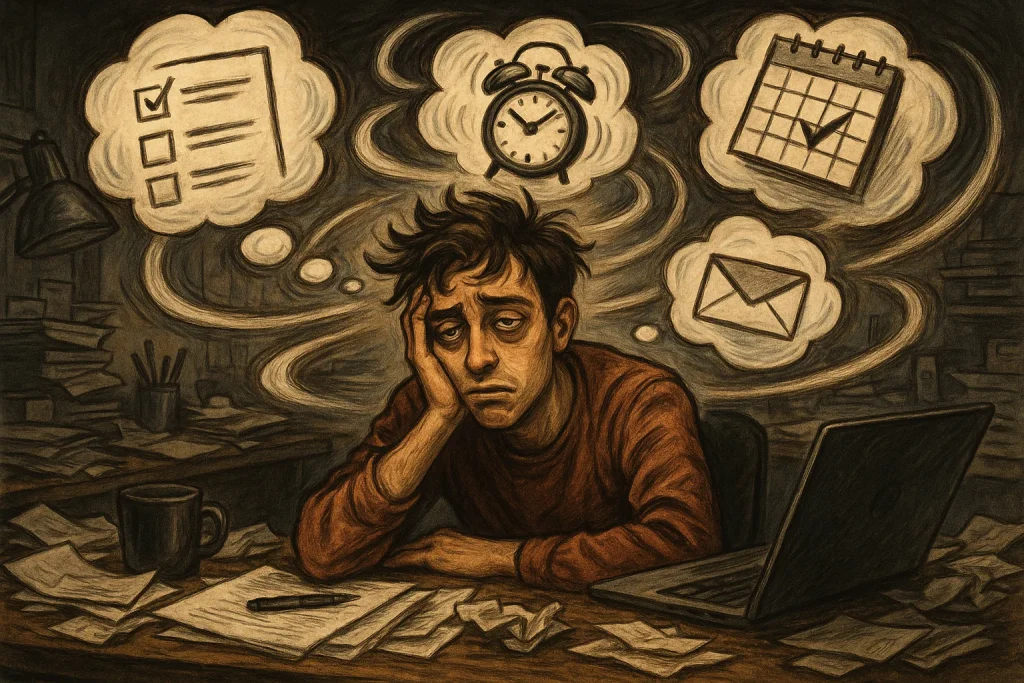
ADHD and Task Switching Fatigue
You know that feeling when you're bouncing between five things and suddenly your brain just… quits? Not even in a dramatic way. Just quietly powers down like it’s had enough. That’s task switching fatigue. And if you’ve got ADHD, you probably know it way too well.
It’s not about being “bad at multitasking” either. It’s the mental cost of shifting your focus, over and over again, until your brain throws its hands up and says, “Nope, I’m done.”
Why Task Switching Feels So Exhausting With ADHD
For neurotypical folks, switching between tasks might feel like a slight pause and then go. For ADHD brains, it’s more like slamming the brakes, doing a full U-turn, and then trying to re-enter traffic without causing an accident. There’s friction. There’s confusion. Sometimes there’s a full-on shutdown.
That’s because ADHD messes with executive function, and executive function is what helps you transition, prioritize, and manage mental energy. If you're already juggling sensory overload (which is super common—see Overloaded ADHD Senses), every switch becomes just one more hit to the system. Eventually, the tank runs dry.
Little Switches Add Up (Fast)
Ever go from writing an email, to replying to a text, to getting up for water, to seeing dirty dishes, to putting one away, to checking the time, to… forgetting why you got up? That’s task switching in action. And your brain is quietly paying a price for each of those pivots.
It might feel small in the moment, but it adds up fast. And if you already started the day at 70% energy, that kind of mental ping-pong can wipe you out by noon.
Paralysis After Too Much Switching
If you’ve ever hit that weird, stuck state where your body is frozen and your brain is spiraling but you can’t actually do anything, that’s ADHD Paralysis. It often shows up after a bunch of back-to-back task switching. One second you're cruising through your list, and the next you’re staring into space wondering how you even got here.
This isn’t dramatic. It’s very real. And it’s something a lot of ADHDers feel but rarely talk about, because it seems too small to count or too weird to explain.
What Helps When You’re Fried
Sometimes all you need is to stop switching. Pick one thing. Just one. Even if it’s “sit here and breathe.” ADHD brains crave stimulation, but they also burn out quicker from over-stimulation. Rest isn’t laziness—it’s required maintenance.
Here are a few gentle ideas that help when the switch fatigue hits hard:
- Time blocking—give your brain a rhythm to follow
- Transition rituals—tiny routines that help your mind move from one task to another
- Body doubling—sit with someone while you work, even virtually
- Ambient music—it creates a mental “room” that helps reduce chaos
- Let things go—no, seriously, drop the ball on purpose sometimes
Your Energy Is Not Unlimited
It’s okay to admit that switching tasks wears you out. It doesn’t mean you’re broken, or weak, or doing life wrong. It just means you’re learning what your brain needs to function well—and that takes honesty and trial and error.
So if your day feels like a series of mental gear shifts that leave you sputtering by mid-afternoon, you’re not alone. You’re not lazy. You’re just navigating the ADHD brain’s very real relationship with energy and focus. Be kind to it.