
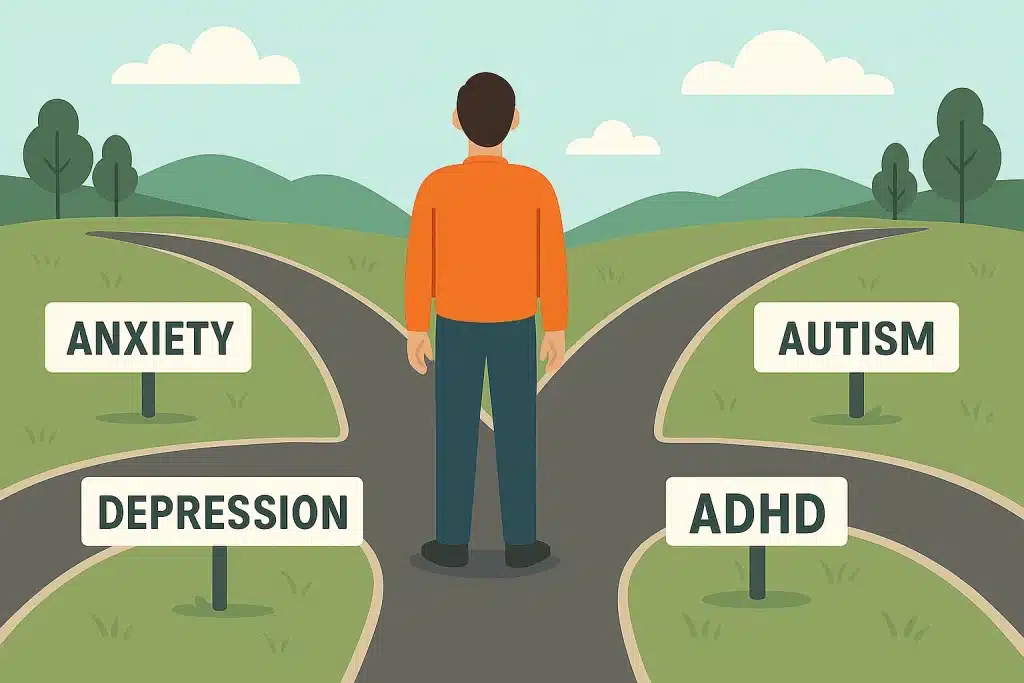
It’s Not Always ADHD: What Else Could Be Going On?
Quick Answer: ADHD shares symptoms with many other conditions, including anxiety, depression, trauma, and sleep disorders. That’s why a proper diagnosis matters—because what looks like ADHD might actually be something else entirely, and getting the right help starts with asking the right questions.
Key Facts
- ADHD is often misdiagnosed, especially in adults and women (ADDitude, 2024).
- Anxiety, depression, PTSD, and sleep disorders can mimic ADHD symptoms (CDC, 2023).
- Only licensed professionals can make an official diagnosis after a full assessment (NIH, 2022).
- Misdiagnosis can lead to ineffective or even harmful treatment plans (Mayo Clinic, 2023).
- Many people report ADHD-like symptoms without meeting clinical criteria (CHADD, 2023).
- Self-awareness and symptom tracking can help clarify what's really going on (ADDitude, 2024).
Why It’s So Easy to Confuse ADHD with Something Else
Let me be honest—this one’s a little uncomfortable. We spend so much time fighting for ADHD to be recognized that it’s hard to admit when we might be wrong. But it happens. I’ve seen people chase ADHD for years, only to realize later that it was trauma. Or anxiety. Or just years of burnout in a system that doesn’t slow down.
And I get it. When you finally find something that explains how your brain works, it feels like *relief*. But that’s why it’s so important to be open to all possibilities. If we rush to claim a label, we might miss what’s really going on underneath.
Conditions That Often Get Mistaken for ADHD
ADHD symptoms like distractibility, forgetfulness, or emotional swings aren’t unique. They show up in other conditions too. Here are a few of the most common:
- Anxiety Disorders: Racing thoughts, restlessness, and trouble focusing—sound familiar?
- Depression: Low motivation and brain fog can mimic inattention and task paralysis.
- Trauma / PTSD: Hypervigilance, irritability, and memory issues often overlap with ADHD.
- Sleep Disorders: Chronic sleep deprivation messes with attention, emotion, and executive function.
- Autism Spectrum Conditions: Sensory overwhelm, social challenges, and rigidity are sometimes mistaken for ADHD.
The tricky part? You can also have more than one of these. ADHD doesn’t cancel out trauma or anxiety—sometimes, they’re all in the mix.
How to Tell If It’s ADHD or Something Else
It’s not about proving anything. It’s about clarity. If you’re wondering whether ADHD is *really* the right fit, start by asking yourself:
- 🧠 Are the symptoms new, or have they been around since childhood?
- 📅 Do symptoms show up across settings (work, home, social)?
- 😰 Do they get worse with stress or anxiety, or stay consistent?
- 🛌 Have I ruled out sleep issues or chronic exhaustion?
- 🗣️ Have I talked to a mental health professional about my full history?
Working with someone who truly understands neurodivergence can help sort through all this—because surface-level symptom lists don’t tell the whole story.
Misdiagnosis Is Hard—But It's Not the End
If you’ve been misdiagnosed, or you’re worried you have been, please know this: it doesn’t mean you faked anything. It means you were searching for answers. And that search was valid. It still is. The goal is never the perfect label—it’s understanding what’s going on inside so you can find what actually helps.
If you’ve ever felt unseen or misunderstood in this process, you’re not alone. That’s something we’ve written about before in our post on Fear of being Misunderstood. It’s a tough part of the journey, but a real one.
Also, check out this guide from ADDitude on ADHD misdiagnosis—it covers even more conditions that can overlap.
FAQs
Q: What’s the most common misdiagnosis instead of ADHD?
A: Anxiety is one of the most common. It can mimic ADHD in how it affects focus, restlessness, and even memory. But it comes from a different place and usually requires different treatment.
Q: Can I have both ADHD and another condition?
A: Absolutely. ADHD often overlaps with anxiety, depression, trauma, and more. That’s why a full evaluation is important—so you’re not treating one while missing another.
Q: What should I do if I’m not sure I have ADHD anymore?
A: Talk to a trusted mental health professional. Bring your questions. Revisit your history. The goal isn’t to “un-diagnose” yourself, but to better understand what your brain actually needs.
Final Thoughts: Stay Open, Stay Curious
It’s okay to question the label. It’s okay to find out it’s something else. ADHD is real—but so is burnout, trauma, anxiety, and every other thing that makes life feel hard. You deserve a clear answer, and you deserve support that fits *you*. Whatever that looks like.