
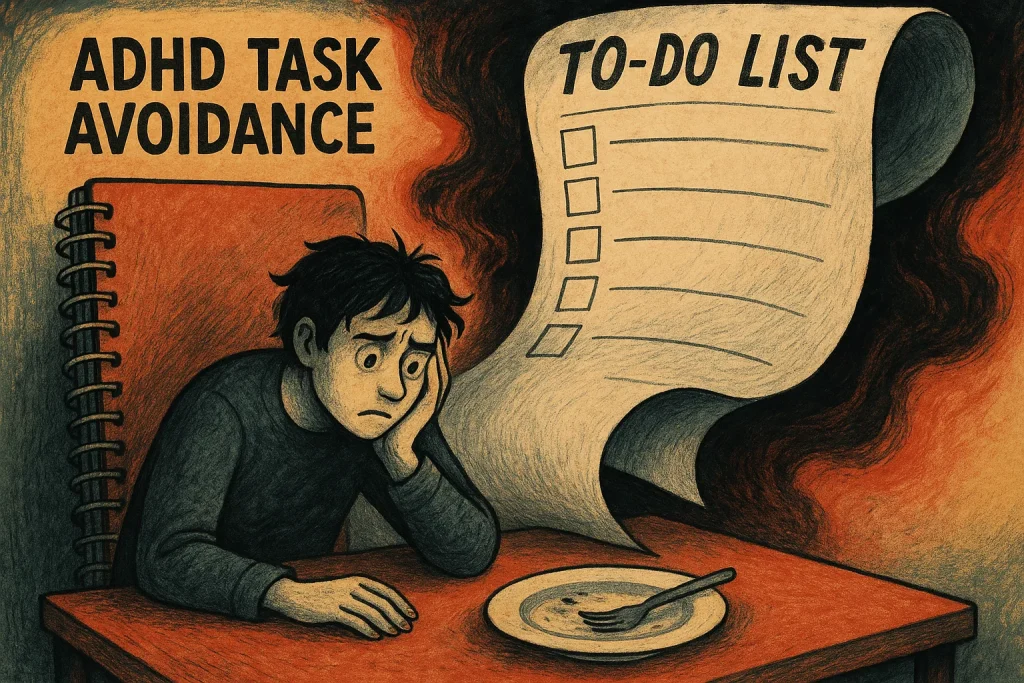
Why You Avoid Tasks With ADHD
Remember that shirt you left hanging on the back of your chair? The one that’s practically become part of the chair now? Or that time you played an extreme version of dish Jenga just to avoid dealing with the mountain of dishes you dodged all week? Yeah. Same.
It’s not laziness. It’s not a lack of caring. It’s ADHD doing what ADHD does best—messing with your sense of time, urgency, and emotional momentum.
Task Avoidance Isn't Just Procrastination
Here’s the thing. Most people think avoiding tasks is about being lazy or procrastinating. But with ADHD, it goes deeper. You can genuinely want to do the thing. You can plan to do the thing. You can have every intention of doing the thing. But the moment comes, and… nothing. It’s like trying to start a car with no gas in the tank. The engine just doesn't turn over.
This isn’t just an annoying personality quirk. It’s connected to something called ADHD Task Initiation. Basically, your brain has a hard time transitioning from intention to action. It’s like the on-ramp to doing things is missing, and you’re just circling the roundabout wondering where the exit is.
Why the Easy Stuff Feels Impossible
People love to say, “Just do it.” Like, cool. Thanks. Let me just unlock the hidden executive function level in my brain real quick. For folks with ADHD, even simple tasks like replying to a text or brushing your teeth can feel like climbing Everest—without any gear. Especially if the task is boring, repetitive, emotionally loaded, or unclear. Which, let’s be honest, covers about 80% of life admin.
And then there’s the shame spiral. You avoid something, it piles up, you feel worse, which makes it harder to start, so you avoid more. Rinse and repeat. You end up sitting in a room full of clutter or unfinished to-dos, wondering why you can’t just be “normal.” But this is normal—for ADHD.
How ADHD Identity Plays a Role
If you’ve got ADHD, you’ve probably struggled with overcommitting too. That "I can totally do all of this!" energy until reality hits. Then you're stuck under a pile of obligations you never had the energy to follow through on. I wrote more about that in Overcommitting with ADHD if you want to go deeper into how we keep setting ourselves up.
When this cycle repeats enough times, it starts messing with how you see yourself. You begin to believe you’re unreliable, flaky, not good enough. But that’s the lie ADHD tells you. Avoiding tasks doesn’t mean you lack discipline or care—it means your brain has a different wiring system, and you need to work with it, not against it.
Some Gentle Workarounds That Actually Help
- Start tiny: Like “open the browser” tiny. That’s a win. You’re moving.
- Use a visual timer: Seeing time pass makes it real.
- Body doubling: Work beside someone else—even virtually. It’s oddly magical.
- Low-pressure lists: Try a “might-do” list instead of a to-do list. Less shame if things roll over.
- Let yourself feel good about small progress: One fork cleaned is still better than zero.
You don’t need to “fix” yourself to be productive. You just need a system that works with the way your brain actually functions. And maybe also give yourself permission to ignore the pile of dishes for one more day if that’s what your nervous system needs right now. That’s okay too.
Final Thought: You're Not Broken
ADHD isn’t a moral failing. It’s not about being lazy, unmotivated, or careless. It’s about your brain being wired to respond differently to tasks, pressure, and energy. Once you recognize that, the goal shifts from “fixing” yourself to understanding yourself. And that’s where things start to click.